Tuesday, May 18, 2010

ID For All?


In his Newsweek May 13th editorial entitled "Why All Americans Should Carry ID Papers," Christopher Dickey proposes a different solution to the controversial Arizona law allowing policemen to search Hispanics that they suspect of being illegal immigrants. He suggests that it would be wisest making it a law requiring to have government-issued identification cards with all people at all times, and that if someone cannot produce their identification, they are to be detained by the police until they are proven to be American citizens or not instead of being instantaneously deported. He says that this would relieve the discriminatory pressures on the Hispanic community that come with the hot-button Arizona law. Also, the fact that these would be cards would mean that it would be far easier to keep track of, instead of having to tote around a birth certificate or a passport. Also, Dickey denounces a section of the Arizona law that states that people may complain to the police department about police officers not being zealous enough in searching for and deporting illegal immigrants.
Personally, I think that this whole situation is rather preposterous. All of this need for constant identification for no other purpose than showing that you are an American citizen is vaguely reminiscent of Stalin-era Communism, where neighbors could turn anyone in for not being enthused enough about the government's policies. In my opinion, these laws, both the one in effect in Arizona and the one proposed by Dickey, are blatant violations of the implied right to privacy as established by Griswold v. Connecticut. Citizens should not be subject to these random interruptions just because a police officer has a sneaking suspicion about them not being legal.
Mary Morris (extra credit)

Primaries put incumbents on the line


According to CNN.com, as this years primaries approach Tuesday, many incumbents are worried that they will not make the cut again. Kentucky, Arkansas, and Pennsylvania are all holding their primary elections on Tuesday. Many politicians are saying, "These contests will put the nation's anti-Washington mood to the test as voters choose between incumbents and anti-establishment candidates." These races are coming into the wake of some tough blows to lawmakers. Sen. Bob Bennett, a three-term senator, did not advance at the Utah GOP convention and Rep. Alan Mollohan did not win over fellow Democrats in last week's West Virginia primary. Leaders from both parties agree..."It's a tough year for experienced politicians."

According to House Speaker Nancy Pelosi, " THere is no question. There is, at this moment, an ant-incumbent mood." In Pennsylvania, Senator Arlen Specter, a five-term incumbent and ex-Republican, is running a close race with Rep. Joe Sestak, a retired Navy admiral. Spectar was a Republican until he crossed party lines to cast a deciding vote on President Obama's Stimulus plan. After he crossed to the other side, he faced plummeting GOP support in his Primary battle against Pat Toomey. In Arkansas, Senator Blanch Lincoln is facing an insurgent campaign in her third term running. Unions and progressive organizations are taking sides with her opponent, Lt. Gov. Bill Halter. Halter had argued with Lincoln for not supporting the Health Care plan option during the debates in Congress. The polls are showing Lincoln with a solid lead. In Kentucky, Trey Grayson and Rand Paul are fighting to succeed Senator Jim unning, a Republican who is not running for re-election. Grayson, the Kentucky secretary of State was the favorite early on in the running. But recent polls show the lead given to Paul, a physician and son of former GOP presidential candidate Rep. Ron paul.

This relates with what we had learned in class because this article is discussing the probability that a well known-incumbent has of being re-elected. They have a well known name, more money to spend on the election campaign, and credit for many successful bills passed. But, it looks like the tides are turning because of the recent uproars in the political world, especially with the new Health Care bill in play. Personally, I can easily see how many people are voting for new candidates, and not incumbents. It has been a rough year for Americans and Obama's new policies have not exactly played in any of these incumbents favor.

By: Katy Miller (Extra Credit)

Sex Offenders Still At Congress's Mercy


In Adam Liptak's New York Times article Extended Civil Commitment of Sex Offenders is Upheld, Liptak discusses the United States v. Comstock ruling and how the Supreme Court ruled that Congress has the authority to allow the continued civil commitment of sex offenders until they have served out their criminal sentence. This is a major win for proponents of strong federal government. Members of pro-decentralization groups such as the Tea Party are raising up in arms against this decision, questioning the Supreme Court's broad interpretation of the resolution, wondering where in Article 1 Congress has been bestowed this authority. Those in favor of the decision point to the "necessary and proper clause" of the Constitution, found in Article 1, section 8.


Personally, I am in favor of the decision that the Supreme Court made. There is often a clear and present need for the further commitment of sex offenders, and it makes sense that their remaining time under their sentence would be spent in a mental hospital, receiving help, as opposed to in jail, which would not be a good reformative environment.

Less Privacy on Facebook


Our article is called The High Price of Facebook and is written by Daniel Lyons. The engineers of facebook are changing the rules. There are certain privacy settings that are being changed. These include where you work, what music you like, and where you go to school. These all go to the public by default. It used to be everything was private until you set your profile to be otherwise, now the privacy is being violated. Some things cannot even be put on private. For example, if you insist on making your hometown, interests and friends names private, you cannot put them at all.
Facebook’s vice president of communications and public policy says “The whole kerfuffle is a misunderstanding” He says they are just trying to make things easier and improve the service it provides to users. They also believe if people don’t share information they have a “less satisfying experience.”
Critics believe the whole privacy “misunderstanding” is just about Facebook wanting to make more money. The original business model of selling ads and putting them on the sides of the pages was insufficient. However, Facebook denies that the changes were for financial benefits.
Facebook also believes that some people like the fact that facebook is more open. However, some people do not agree with these changes at all. For example, in April, three senators told Facebook to change their privacy policy. They also urged the Federal Trade Commission to put forth a series of guidelines for social networking sites like Facebook. Also, a interest group involving online-privacy filed a complaint to the FTC stating "unfair and deceptive trade practices."
In the end, the privacy issue shouldn’t hurt facebook at all. They have over 400 million members, and most are oblivious the issues of privacy. Facebook will be fine with the small amount of upset people, and will most likely be considered this years Microsoft.
This article is related to what we learned in government because it deals with the unremunerated right of privacy. It also involves the roles interest groups can have on company’s and policy making. Also that senators can influence the way online companies can work. However privacy is the largest part of this article. People have the right to privacy by the ninth, fourth, first, and many more amendments.

Photo Credit: http://www.flickr.com/photos/signalnoiseart/3112854245/

Post by: M.Laycock and S.Romell

Monday, May 17, 2010

Rulings: Sex offenders, teen sentences, overseas custody


In a May 17th 2010 article, Rulings: Sex offenders, teen sentences, overseas custody: On Monday the Supreme Court ruled that sentencing some juvenile criminals to life in prison without parole is cruel and unusual punishment, especially when the cases do not involve murder. Six out of the nine judges ruled in one particular case that it was unconstitutional to be sentenced life without parole because of kids young age. Tarrance Graham was sentenced to life without parole for robberies he did while he was sixteen and seventeen. This case was really important because the Supreme Court chooses from thousands of cases to hear and most cases stop at the Court of Appeals.I agree with the Supreme court, especially when the case does not have to do with murders. If it had to do with murders or violent crimes I would have a completely different stance. Although these felons are committing serious crimes in some cases they don't realize what they're doing at such a young age. I don't believe that committing a crime, such as robbery should land you in jail for the rest of your life.


Posted By: Christina McGee

Transocean hires U.S. lobby firm to work Congress

This article, which was written on May 13, 2010, summarizes the issues Transocean is dealing with regarding the explosion of the oil rig right off of the shores of Louisiana. Because of these issues, Transocean hired a United States lobby firm to work Congress to back their situation. The firm, called Capitol Hill Consulting Group registered as a lobbyist for Transocean and is hoping to smooth out the conflict between BP, Transocean, and Halliburton. Each of the oil rig powers are blaming each other for the horrific accident, so Transocean took it upon themselves to lobby Congress for a positive result. In the past, Transocean has donated less than $100,000 on lobbying tax issues, but since the accident, employees and others have spent a little more than $10,000 in campaign contributions to members of the House and Senate to gain backing from the government. Hopefully for Transocean, the Capitol Hill Consulting Group will appear in front of the Senate and House of Representatives oversight committees in order to gain support, an answer as to who is to blame, and possibly funding to fix the problem that the sinking of the Deepwater Horizon has caused on the environment and the lives of others. This article was significant to our studies of interest groups and the study of lobbying and congress. Interest groups would lobby Congress to get their voices heard and rally support, just as Transocean is lobbying Congress to rally support for their company (even if it means throwing BP and Halliburton under the bus). If this technique works to the advantage of Transocean, the blame will be lifted from their shoulders and onto those of the other group. I sure do hope it works, because as long as these three groups keep disregarding their involvement in this tragedy and the less government gets involved, the more time we are wasting watching our environment fade away.

Photo Credit
Article Credit May 13, 2010

NAACP Supports Kagan


The article in the Austin American Statesman, NAACP backs Obama's Supreme Court nominee Kagan, confirms support from the NAACP for Kagan. Then NAACP were hesitant at first to back Kagan because of her lack of experience as a judge and her unknown strength on civil rights issues. The board was swayed by Kagan's work as solicitor general, her time as a White House aid under Clinton, and clerk time for Thrugood Marshall. When working in the White House, Kagan fought to strengthen hate crime legislation and civil right enforcement. This background won Kagan unanimous support on the board of NAACP, America's oldest and largest civil rights interest group. This article shows the indirect influence of interest group in the nomination system. The President presents a Supreme Court nominee and Congress confirms them, but the public support of interest groups are very important.
MWeidmann

Kagan Keeps Quiet


This article is about Elena Kagan’s political beliefs and personal life and how they would affect her nomination. People are trying to find dirt on her, such as political beliefs or conduct that would look bad to the public, but nothing can be found. She has never made public statements regarding her political opinion, and nothing can be found out about her personal life. After a major search by the New York Times they couldn’t even find out where she lives, if she’s ever dated anyone (guy or girl) or if she even lives in a house. Republicans and Democrats alike are worried about her political stances because they have no clue where she stands because she keeps so quite out them. She is one of the most secretive nominees ever in history.

This article demonstrates how quiet and secretive Judicial nominees have to be. Nominee’s always avoid controversial questions and have squeaky clean or secretive backgrounds because of the harsh scrutiny that the opposing party could raise. Once scrutiny has been raised there is real possibility that the nominee could be Borked by Congress, and that is why Kagan has kept so quiet on political issues and been so secretive about her past.

I feel that not answering questions, especially ones about her sexuality, is a good strategy and the right strategy. If she wants to get the nomination she needs to keep quiet on such issues that the general public has mixed feelings on.

Supreme Court Nomination Troubles


By: Zane Kuhlman
This article on Solicitor General Elena Kagan’s Military Policy, states that she banned Army recruitment on the Havard campus during her time as dean. She made the Army recruiters go to a different area than other recruiters and reversed the policy allowing them to go everywhere on campus to recruit. She reportedly denied them access due to the “Don’t Ask Don’t Tell” policy. Newt Gringrich voiced his opinion on the matter stating “And that is an act so unbecoming of an American that she should be disqualified from the very beginning.” Should Kagan be denied confirmation to the Supreme Court because of her view on the Military? I think that it is something that should be seriously considered during the confirmation process.
Supreme Court rules against life without parole for minors!


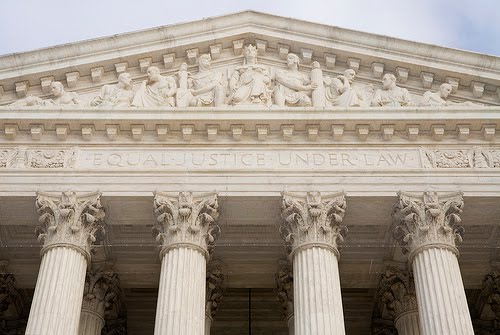
U.S Supreme Court Building
In this May 17th article by the Associated Press a recent Supreme Court decision is discussed. The Supreme Court just ruled that a minor, that is somebody under the age of 18, may not be given a life sentence without the possibility of parole for a non-homicidal crime. There was also nearly a decision that a minor could not be given a life sentence without parole for any crime, including homicide, but there was a 5-4 decision against that.

This article demonstrates the Supreme Courts exercise of judicial review. By casting their 5 to 4 vote, the court ruled that teenagers may not be locked up for life without chance of parole if they haven't killed anyone. The article is also gives an example of federalism. Although the states denied these offenders any parole, the Supreme Court’s decision overrules the states’ previous decisions and displays the power the national government has over the states.

We disagree with the Supreme Court’s decision. We believe the state judges should have the authority to make their own decision on whether or not the individual (based on the specific case) should be able to get parole.


Photo credit: http://www.flickr.com/photos/bootbearwdc/37621686/


Grade This Post.


By: Chris D., Jackie K., and Sarah G.


Supreme Court Restricts Life Sentences for Juveniles


The article I found is called “Supreme Court Restricts Life Sentences for Juveniles”. It stated that the “U.S. Supreme Court has ruled that teenagers may not be locked up in prison for life with no chance of parole if they have not killed anyone.” This ruling came within the case of Terrance Graham. He was implicated in a series of armed robberies at age 17. Now Graham is 22 years old and is in prison in Florida.

Justice Anthony Kennedy stated that “The state has denied him any chance to later demonstrate that he is fit to rejoin society based solely on a nonhomicide crime that he committed while he was a child in the eyes of the law.” He also expressed that “This the Eighth Amendment does not permit.” Chief Justice Roberts also agreed with Justice Anthony Kennedy and four others on the Supreme Court, all liberals.

However, Roberts believes that it should not “extend to all young offenders who are locked up for crimes other than murder. By a 5-4 vote, the Supreme Court decided that “the U.S. Constitution requires that young people serving life sentences must at least be considered for release.”

The Supreme Court receives thousands of cases in a year, but they only choose around sixty of them to decide. That means that the case of Terrance Graham made it all the way from the district courts to the appeals courts to the Supreme Court. This is a very long process and the majority of cases don’t make it past the Court of Appeals.

All in all, this is an important case in United States History. Anytime that the Supreme Court makes a ruling on a case, it sets a precedent for the future interpretation of our constitution.

posted by: M. Laycock

photo credit: http://www.flickr.com/photos/waynekessler/4514980675/


Arizona Bill


According to the New York Times, On Friday April 23rd, Jan Brewer signed into law a bill which would help to prevent illegal immigration and is now considered one of the most severe bills in the nation to date. Even Obama criticized the bill, as well as many protestors. Obama claimed at the press conference that the bill would “…undermine basic notions of fairness that we cherish as Americans, as well as the trust between police and our communities that is so crucial to keeping us safe.” The bill stated that any immigrant would be required to carry their papers at all times or be subject to detainment. The opponents of the bill argue that this will increase discrimination against Hispanics and be cause for further harassment. This would also increase the amount of power that the police force holds. The bill has cause Mexico’s Foreign Ministry to fear for the lives of their people and those in relation to these immigrants.

Brewer ensured the public that the police force would not enact racial profiling, but this somewhat contradicts the foundation of the bill itself, which is based on judging whether or not a person is an immigrant and demanding identification.

This relates to what we’ve learned in Government because the fact that Obama criticized the bill, but Brewer still had the right to disregard his opinions. This shows the separation of powers between the state and national government.

The immigrants could apply the 9th amendment (the unenumerated rights) to their side of the story. They could argue that they have the right to privacy under this amendment. The government officials could say that they have probable cause to search or detain under the 4th amendment.

We disagree with the extremity of the bill. It may cause even more discrimination than is already occurring. On the other hand, it would increase the security of our nation, and carrying around papers is not any more of a burden than to have a driver’s license on hand. The principle of racial profiling is where the controversy lies.
By: Lauren Baggett & Katy Miller

U.S. Approval of Killing of Cleric Causes Unease


Anwar al-Awlaki, who is an American born terrorism suspect supposedly hiding in Yemen has been placed on the CIA kill list. The kill list authorizes the CIA to take out a potential enemy to the United States. Anwar al-Awlaki’s name has been linked back to the Christmas day bombings and the Times Square bombings. He is a preacher who supports the active war against the United States.

There is controversy surrounding this matter, because of the fifth amendment and, as a citizen, whether he has the right to due process of law. When american born citizens fought for the nazi party in World War II, they were given no “special treatment,” but as times have changed, the question now arises of these treasonists rights. But, there have been instances in the past when the CIA has wrongfully captured suspects, and if they had been put on the kill list, they would have been innocently murdered.

Alexa: I think that it is safe to say that our country should be protected at all costs. But, if these costs include other people’s lives, we should be extrememly careful when taking a life. Above all, before resorting to killing these people, we should try every means possible to capture them and bring them to justice in a different way. Because mistakes by the CIA are highly publicized, we often get a one sided story, we should in fact not all of the guilty people that have been brought to justice by these tough investigations. Since fighting against the United States would likely be considered treason by the framers, I think that by engaging in acts of terror, our citizens lose their protections under our law.

Helen: What’s the harm in giving Awlaki a trial? It doesn’t seem right that the CIA needs a court warrant to eavesdrop on his cell phone calls but needs no sort of judicial review to kill him. One of the main functions of the judicial branch is to check the executive branch, and that function should be maintained. The CIA is composed of humans, and humans can be fallible, as the CIA has been in the past. Precautions should be taken to make sure that no mistakes are made.


Posted by: H. Anderson and A. Witowski

Getting Rid of Nuclar Weapons


Seen on CNN, Obama to Submit Nuclear Arms Treaty to the Senate, Obama has sent a treaty to the Senate for ratification detailing The Strategic Arms Reduction Treaty. This treaty cuts the number of nuclear weapons held by the US and Russia by a third, and sets a limit for both countries at 1550 nuclear warheads and 700 delivery vehicles. The Republicans in Congress are hesitant to support this treaty because they are concerned over the effectiveness of the treaty and the country's defenses. This is a current example of Congress's check on the President in foreign policy. The President can negotiate treaties, but Senate must ratify treaties with a 2/3 majority vote.
MWeidmann
WWillson

Friday, May 14, 2010

Proposed Ban on Pacific Drilling

Proposed Ban on Pacific Drilling

May 13, 2010


In the ‘Western Senators Propose Ban on Pacific Drilling’ article, West Coast senators proposed a permanent ban on oil drilling in the Pacific on Thursday. Shortly after the Gulf accident, Governor Arnold Schwarzenegger withdrew a plan for new offshore drilling. Since there was no current plan to present the problem of offshore drilling, the move made by senators from Oregon, California and Washington was highly symbolic. On Thursday Senators Frank R. Lautenberg and Robert Menendez from New Jersey and Senator Bill Nelson of Florida, all Democrats, tried to raise oil company liability because the current statistics only represent a small fraction of the damage caused by the BP spill in the Gulf.

While these Senators were busy trying to push the bill, Senator Lisa Murkowski, Republican of Alaska, was busy blocking their bill. She claimed their bill discouraged all oil exploration. The Democrats are not letting this stop them though; they are going to try again to change the liability law.


Due to the recent oil spill in the Gulf of Mexico, Democratic Senators from several states are pushing for the costs of the oil company liability in a spill from $75 million to $10 billion. States such as Alaska are against this because they say it will discourage oil drillers from taking such a risk. This disagreement is an example of the senator’s different political beliefs and how it affects their policymaking in the Senate.

The Minerals Management Service is responsible for promoting oil exploration and collecting royalties from it, as well as regulating the safety and environmental practices of oil drilling. The Secretary of the Interior, Ken Salazar, would like to split up the two main functions of this agency because he feels like their interests conflict with each other. He also wanted to do the split to end the sometimes-too-close relationship between government officials and regulated companies.


We belive that the offshore drilling should continue, but the liability price should be increased. This could discourage some drillers, but that might not be the worst thing.


Grade This Post
Submitted by: Anne Lucado and Hannah Slovacek

BP Says Leak May Be Closer to a Solution


In the article, "BP Say Leak May Be Closer to a Solution," the New York Times discusses BP's latest initiatives to stop the catastrophic oil spill in the Gulf of Mexico. The spill started several weeks ago and is due to "a calamitous series of equipment and operational failures," according to Representative Henry Waxman of California. BP will be trying several different tactics to slow and ultimately stop the leak soon, so that it will stop in weeks, rather than months. Congress has passed a $118 million packet of actions to combat the spill and aid those hurt in the disaster.

photo credit: http://www.nytimes.com/2010/05/13/us/13spill.html

Grade this Post

Stripping Terrorists of American Citizenship

In the article, Bill aims to strip certain Americans of their citizenship, by Ed Hornick of CNN on May 7th, 2010. There is a bill being introduced to Congress that would allow the government to strip people of their citizenship if they are believed to be involved in terrorist actions. The bill is being introduced by a bi-partisan group, some of which are saying that they are simply updating the 1940 bill, the Immigration and Nationality Act, to fit the present times. There are critics of the bill who say that this is a direct reaction to the attempted car bombing of Time Square. The group claims that their actions are based on the current situation with the wars we are fighting, and the world we live in. This bill could violate a citizens civil liberities, by going against the framers original idea of any citizen guilty or innocent to receive due process of the law. The bill includes clauses that could potentionally violate the original intent of the constitution involving how treason should be viewed. In our opinion this bill could be potentionally dangerous to civil liberties. While we think the idea behind the bill would be helpful, like the Speaker of the House, we would like to know what consistutes terrorism, we would like to see the definition of what would strip someone of their citizenship to the United States.

Posted by TFavaron and EMckee

Photo Credit: http://www.flickr.com/photos/boyds/1266529437/sizes/m/

First steps toward renewable resources


This Newsweek article, dated May 12, 2010, describes the first debates on a packed energy bill (called the American Power Act or the Kerry-Lieberman bill) designed to fight climate change. The bill includes $54 billion in federal loan guarantees for nuclear proponents, subsidies for companies that use/create renewable energy, and incentives for “clean coal” researchers. The bill also addresses the hot topic of oil drilling, which will increase but states can reject plans of drilling within 75 miles of their coastline.


The timing of this bill is precarious, as it immediately follows the huge oil spill in the Gulf of Mexico, and drilling’s reputation is less than spectacular at the moment.
Initially, environmentalists weren’t impressed with Kerry’s draft but have offered some support since.


We think this bill is a step in the right direction. Even if it doesn’t stop climate change or switch all energy sources to renewable energy, it’s better than doing nothing.
By Brooke Adair & Alex Bishop

Balancing the Budget

In Newsweek's article, Wake Up, America by Robert J. Samuelson published on May 13, 2010, Samuelson thinks that the current European economic crisis needs to be an example for America. To him, Americans aren't seriously considering that this could happen to us because of the size of our national debt.
The hard part about balancing the budget is that very few politicians want to do it. Liberals want to keep social spending and conservatives want to keep defense spending. Neither really want to raise taxes, especially conservatives, and that would be necessary if we wanted to balance the budget while we keep spending.
The significance of this issue is how large the scope of the government should be. The larger it is, the harder it is to balance the budget.
Obama has made a "National Commission on Fiscal Responsibility and Reform" but has done little else to balance the budget.
We think that our growing national debt is a serious threat. But it is difficult for our country to balance how much we spend with how much we tax. The politicians should make balancing the budget a more prominent issue on the policy agenda and maybe over time, America's budget could be back on track.

By: Alex Kelly and Sarah Lapotin

photo credit: http://www.flickr.com/photos/inkyfingerz/454976773/

Obama to submit nuclear arms treaty to Senate

Obama and the Russian president recently ratifyed a treaty to reduce the total amount of nuclear arms held by each country by approximately 1/3. However, republicans are skeptic about this treaty because they wonder if the nuclear reduction will decrease the ability the nation holds to defend its self from foregin powers. This treaty is called START (The Strategic Arms Reduction Treaty).

The significance of our article is the following: it sets a good example that our president follows through with his personal platform and is working towards his goal to reduce world arms threats. Obama also deemed the treaty "the most comprehensive arms control agreement in nearly two decades."


Article credit: http://news.blogs.cnn.com/2010/05/13/obama-to-submit-nuclear-arms-treaty-to-senate/

Photo credit: http://www.flickr.com/photos/tonirodrigo/3133355832/

Jason Powell
Jeff Stice