Showing posts with label Supreme Court. Show all posts

Tuesday, May 18, 2010

Sex Offenders Still At Congress's Mercy


In Adam Liptak's New York Times article Extended Civil Commitment of Sex Offenders is Upheld, Liptak discusses the United States v. Comstock ruling and how the Supreme Court ruled that Congress has the authority to allow the continued civil commitment of sex offenders until they have served out their criminal sentence. This is a major win for proponents of strong federal government. Members of pro-decentralization groups such as the Tea Party are raising up in arms against this decision, questioning the Supreme Court's broad interpretation of the resolution, wondering where in Article 1 Congress has been bestowed this authority. Those in favor of the decision point to the "necessary and proper clause" of the Constitution, found in Article 1, section 8.


Personally, I am in favor of the decision that the Supreme Court made. There is often a clear and present need for the further commitment of sex offenders, and it makes sense that their remaining time under their sentence would be spent in a mental hospital, receiving help, as opposed to in jail, which would not be a good reformative environment.

Monday, May 17, 2010

Supreme Court rules against life without parole for minors!


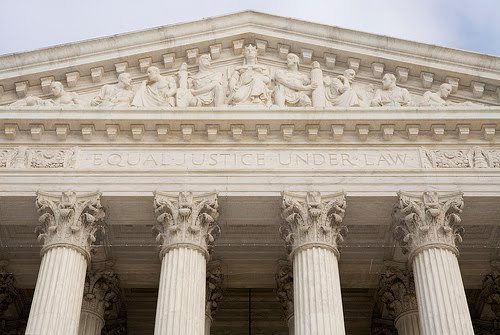
U.S Supreme Court Building
In this May 17th article by the Associated Press a recent Supreme Court decision is discussed. The Supreme Court just ruled that a minor, that is somebody under the age of 18, may not be given a life sentence without the possibility of parole for a non-homicidal crime. There was also nearly a decision that a minor could not be given a life sentence without parole for any crime, including homicide, but there was a 5-4 decision against that.

This article demonstrates the Supreme Courts exercise of judicial review. By casting their 5 to 4 vote, the court ruled that teenagers may not be locked up for life without chance of parole if they haven't killed anyone. The article is also gives an example of federalism. Although the states denied these offenders any parole, the Supreme Court’s decision overrules the states’ previous decisions and displays the power the national government has over the states.

We disagree with the Supreme Court’s decision. We believe the state judges should have the authority to make their own decision on whether or not the individual (based on the specific case) should be able to get parole.


Photo credit: http://www.flickr.com/photos/bootbearwdc/37621686/


Grade This Post.


By: Chris D., Jackie K., and Sarah G.


Supreme Court Restricts Life Sentences for Juveniles


The article I found is called “Supreme Court Restricts Life Sentences for Juveniles”. It stated that the “U.S. Supreme Court has ruled that teenagers may not be locked up in prison for life with no chance of parole if they have not killed anyone.” This ruling came within the case of Terrance Graham. He was implicated in a series of armed robberies at age 17. Now Graham is 22 years old and is in prison in Florida.

Justice Anthony Kennedy stated that “The state has denied him any chance to later demonstrate that he is fit to rejoin society based solely on a nonhomicide crime that he committed while he was a child in the eyes of the law.” He also expressed that “This the Eighth Amendment does not permit.” Chief Justice Roberts also agreed with Justice Anthony Kennedy and four others on the Supreme Court, all liberals.

However, Roberts believes that it should not “extend to all young offenders who are locked up for crimes other than murder. By a 5-4 vote, the Supreme Court decided that “the U.S. Constitution requires that young people serving life sentences must at least be considered for release.”

The Supreme Court receives thousands of cases in a year, but they only choose around sixty of them to decide. That means that the case of Terrance Graham made it all the way from the district courts to the appeals courts to the Supreme Court. This is a very long process and the majority of cases don’t make it past the Court of Appeals.

All in all, this is an important case in United States History. Anytime that the Supreme Court makes a ruling on a case, it sets a precedent for the future interpretation of our constitution.

posted by: M. Laycock

photo credit: http://www.flickr.com/photos/waynekessler/4514980675/


Wednesday, May 12, 2010

Obama makes choice for Supreme Court nomination


The article, "Obama Picks Kagan, Scholar but Not Judge, for Court Seat," discusses Obama's choice to nominate Elena Kagan as the next Supreme Court Justice. Ms. Kagan has some impressive credentials: she studied at both Oxford and Harvard Law, she was the dean of Harvard law school, and for the past year has served as the United States solicitor general. However, if confirmed, she will be the first Justice since Thurgood Marshall to not have prior judgeship experience before serving on the Supreme Court. Some critics are concerned about her lack of experience, but President Obama insist that she is "one of the nation's foremost legal minds."
Analysts predict "a fight over her confirmation but not necessarily an all-out war." The White House hopes that the Senate Judiciary Committee will hold hearings by July 4.

-Mary M. and Maddie R.

Tuesday, May 11, 2010

Elena Kagan ain't gettin' by easy!


As Senate Judiciary chairman, Patrick J. Leahy (D-Vt.), shown on the Capitol subway, will oversee Elena Kagan's confirmation hearings.
Senate Judiciary chairman, Patrick J. Leahy (D-Vt.),
will oversee Elena Kagan's confirmation hearings.


The May 11 Washington Post Article, "Elena Kagan nomination for Supreme Court riles both sides of political aisle," discusses the process that wil occur in trying to get Elena Kagan confirmed. She is an interesting case because she has no prior judicial experience. Although she has great credentials, both conservatives and liberals aren't completely confident in Kagan because they don't know where she stands on a plethora of issues. She does, however, have a rich history in law--even becoming the Dean of Harvard Law School. Kagan took some heat for a state she made in the confirmation process for Solicitor General about indefinite detention of combatants not on an actual battlefield. Both sides wait eagerly for the nomination hearings.

This is relevant for a number of reasons. A position on the Supreme Court is one of the most prestigious and powerful positions in our government, and also the best way for a president to leave his legacy. The confirmation process will be both difficult and easy at the same time. Difficult becuase many Senators will be apprehensive due to not knowing where Kagan stands on the issues. It will also be somewhat easy for Kagan because she has no prior judicial decisions to defend. This confirmation would be historic because it would be the first time for there to be three women on the Supreme Court at one time. I think that Kagan will end up getting the confirmation with a little breathing room to spare.


Photo Credit: Melina Mara/the Washington Post

Grade This Post.

By: Chris D.

Monday, May 10, 2010

Obama's Choice

Photo Credit: www.cnn.com


Article: "Women's Court" http://www.newsweek.com/id/237338 (5/3/2010)

With the resignation of John Paul Stevens, President Barack Hussain Obama will get to make his second Supreme Court justice nomination. Since Stevens was considered the most liberal justice on the court, Obama will not have a chance to drastically change the ideological makeup of the court with his nomination. Also, in years to come, the likely justices to retire are all the most liberal ones, so it is likely that within his presidency, Obama will never get the chance to change basic ideological makeup of the court. Instead, he will turn to other characteristics to change the court. Several of the potential choices are women with diverse perspectives. Among the potential women nominees are Elena Kagen, the first woman solicitor general and a dean of Harvard Law school, Diane Wood, a judge on the seventh circuit court of appeals, and Janet Napolitano, the secretary of homeland Security.

This article displays the Supreme Court nominee selection process. It confirms that justices are chosen carefully by the president. Once Obama makes his selection for nominee, she (or he) will have to be confirmed by the Supreme Court.

The nominee will be Elena Kagen; if confirmed, she will add gender diversity to the court. Her occupations have not included any terms as a judge, so it will be interesting to see if that affects her nomination.


Posted by Helen Anderson and Alexa Witowski